introducing the genus echo
Look deep inside every fruit with the Genus Echo
Orbem's AI-powered MRI detects hidden defects in every single piece of fruit and ensures precise classification as well as grading, without damaging the fruit.
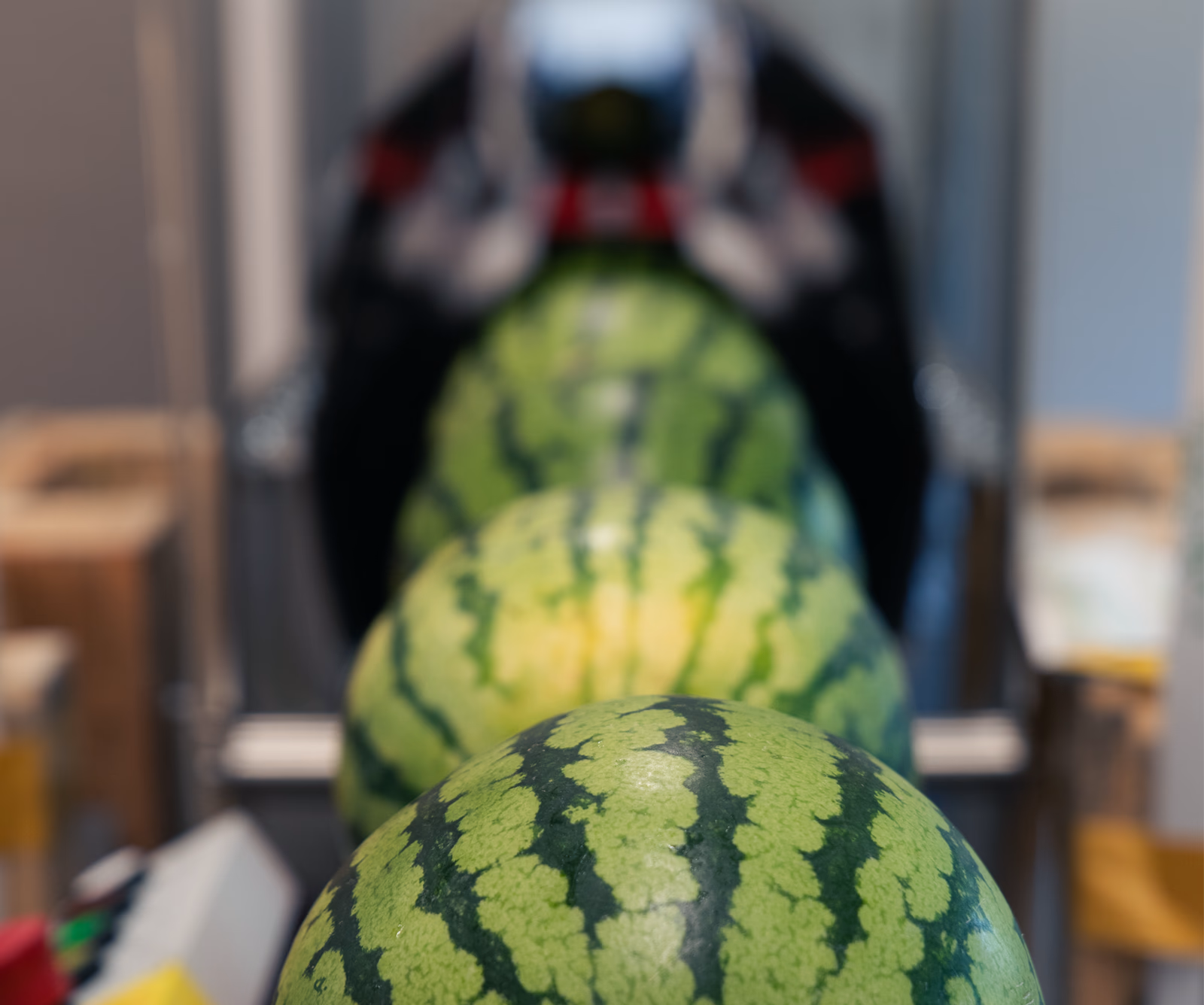
What if we could reduce watermelon shipment rejection rates from 3.5% to 1%?
Destructive sampling and the know-how of a few experienced tappers are the only ways U.S. fruit producers currently assess the quality of their watermelons before shipping.
The problem? Most of the fruit remains unseen inside.
A buyer will inspect and cut open only a handful of fruit before deciding if a shipment meets expectations. Watermelon producers in the U.S. currently face shipment rejection rates of 3.5% on average.
The solution? Non-destructive quality control that looks deep inside every fruit.
Destructive sampling only tells us about the internal quality of selected pieces of fruit. It says nothing about the internal quality of entire shipments. Nevertheless, both fruit producers and retailers base their decisions on the assumption that the internal quality of one fruit matches the internal quality of all.
With the Genus Echo, fruit producers are no longer blind to what is really going on inside their fruit. Knowing what every fruit looks like on the inside, producers can guarantee consistent quality, resulting in fewer rejected shipments and therefore in lower operational cost.
One shipment holds thousands of fruits but the decision rests on a handful.
For a representative 60-million-pound operation, the modeled savings of moving from a 3.5% rejection rate to a 1% target can reach approximately $700,000 per season.
SHIPMENT REFERENCE
40,000 lb
SHIPMENTS PER SEASON
1,500
AVOIDED REJECTIONS
37.5
SEASON VOLUME
60M lb
.avif)
REJECTION RATE TREND
Using the Genus Echo to determine internal quality before shipping allows fruit producers to reduce operational cost associated with rejected loads and inconsistent quality.

Stop spending on freight or rereouting for rejected loads.

Preserve brand reputation when internal quality is known before the fruit ships.

Reduce manual labor and redeploy staff.

Stop opening fruit at packed value.

Document claims tied to internal quality instead of destructive sampling.
Orbem's Genus Echo inspects internal watermelon quality non-destructively at up to 44,000 lb/hour.
While sampling uses a few fruits to represent a shipment, the Genus Echo provides internal-quality information before fruit reaches the buyer. This informs grading, holding, releasing, routing, field and variety analysis, and buyer-specific quality management.
Answers to the most common questions about watermelon quality control in the U.S.

A commonly cited field reference is around 3.5%, though this is a practical benchmark from direct grower/packer observation rather than a statistically representative national average — actual rates vary by operation.
For a representative 60-million-pound seasonal operation, cutting rejections from 3.5% to a 1% target can result in savings of roughly $700,000 per season in an upper-bound scenario — combining avoided freight, recovered product value, QC labor savings, and reduced claims/chargebacks.
Cutting open every fruit would destroy the product being sold, so buyers and packers rely on sampling a small number of watermelons to represent an entire load — often just a handful out of thousands of fruit.
Internal quality issues may not be evenly distributed through a load, so the commercial decision (accept/reject/reroute) ends up resting on incomplete information — which the report argues is a bigger cost driver than the sampled fruit itself.
Four modeled sources: avoided freight/rerouting costs, recovered product value, QC labor savings or redeployment, and avoided claims/chargebacks — plus a fifth, operation-specific source (destructively sampled fruit) that's excluded from the headline number.
It's a method of assessing internal fruit quality without cutting the watermelon open — for example, Orbem's Genus Echo technology, which the report says can inspect at up to 44,000 lb/hour, enabling every-fruit checks instead of small samples.
No — the report explicitly frames it as an upper-bound modeled scenario with 100% capture assumed, not independently validated industry research or a guaranteed outcome; actual savings depend on volume, rejection frequency, freight exposure, and other operation-specific factors.
_result.avif)