Last week, the European Commission released a long-term strategy to build a strong and resilient European livestock sector: a brand new EU Livestock Strategy. A plan to ensure Europe’s food security while reducing import dependencies is now on the table and it has the potential to change the future of EU livestock farming.
Given that the sector employs about 7 million people across Europe and generates €400 billion in annual turnover, a good plan to future-proof seems truly necessary for an industry facing so many challenges. Challenges such as animal diseases, rising costs, environmental challenges, and low profitability, to name a few. In addition, consumer expectations around sustainability and animal welfare keep growing: expectations the EU must be able to meet without having to resort to import.
To tackle those issues proactively and to protect Europe’s food security over time, the EU Livestock Strategy provides a long-term plan for building a resilient, competitive, sustainable livestock sector that simultaneously supports vulnerable regions.
And what does this plan look like? The EU Livestock strategy details a number of measures, to be implemented as a coordinated action between the European Commission, Member States and stakeholders across the livestock value chain.
Key measures at a glance
- Investment
- Financial support (and adequate transition periods) to facilitate the transition to cage-free systems, bioeconomy and more.
- Developing a livestock risk-management financial scheme.
- Ensuring adequate financing for the prevention, surveillance, control and eradication of animal diseases.
- Supporting investments in climate adaptation, mitigation and innovation.
- Financing sustainability and animal welfare investments.
- Supporting livestock systems that contribute to the vitality of rural and remote areas.
- Developing the European Excellence Scheme to better valorize higher standards and sustainability.
- Education, innovation, and promotion
- Encouraging the adoption of digital technologies to improve animal health and welfare.
- Supporting the development of circular bioeconomy.
- Developing a Roadmap for more efficient and sustainable circulation of nutrients across the EU.
- Raising awareness of the quality, sustainability and diversity of European livestock products.
- Promoting sustainable EU livestock products through promotion policies and the Buy European campaign.
- Preserving the central role of livestock farming as an economic, social and environmental asset for Europe's territories.
- Promoting higher international production standards.
- Promoting European livestock products through agri-food diplomacy and high-level missions.
- Regulations and collaboration
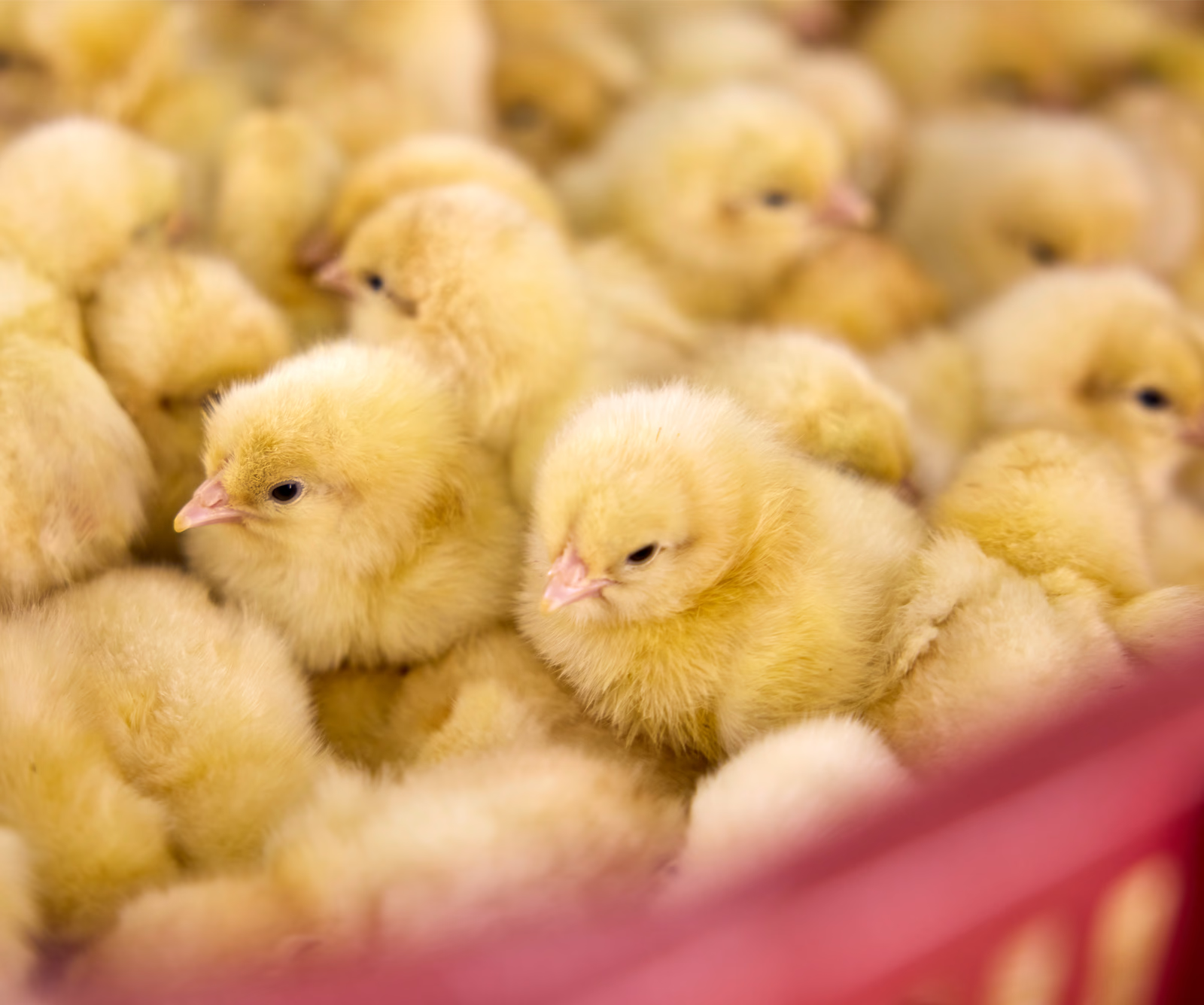
- Revising animal welfare rules for laying hens and broilers by the end of 2026, focusing on the phasing-out of cages, practical on-farm welfare indicators, ending the systematic killing of male chicks and introducing WTO-compliant equivalent import requirements.
- Simplifying EU rules to allow for innovative solutions, notably in circular bioeconomy.
- Providing a framework for optional reserved terms highlighting specific production methods and characteristics.
- Encouraging labelling and clear EU origin.
- Working with Member States to restore production in regions at risk of land abandonment.
- Issuing CAP recommendations on environmental sustainability, climate action and animal welfare.
- Developing a harmonised methodology to measure livestock emissions at EU farm level.
- Introducing WTO-compatible reciprocity conditions for imports.
Whether this long-term framework can truly future-proof the sector depends on implementation speed, Member State uptake, and whether financial support keeps pace with the scale of transition costs farmers face.
What the EU Livestock Strategy means for the poultry sector
For poultry, the strategy's most concrete commitment is that by the end of 2026, the Commission wants a revision that ends male chick culling. This strategy turns a patchwork of national bans into one European direction.
In-ovo sexing is the technology that makes this possible. Orbem’s non-invasive in-ovo sexing solution, the Genus Focus, is already installed in commercial hatcheries in five European countries and in the US. It identifies the sex of an embryo on days 11 and 12 of incubation using AI and MRI, across all commercial breeds. Fewer than 1% of males hatch. So the strategy's mentioned promotion of digital tools for animal welfare (supported by EU funding) is describing a future that we do not need to invent from scratch. Because it is something hatcheries are already installing.
The financial support attached to the welfare revisions matters just as much as revised regulations. The Commission is honest that in-ovo sexing is not yet within reach of every small and mid-sized hatchery. That is exactly what the funding is for. As Olivér Várhelyi, Commissioner for Health and Animal Welfare, puts it, this new strategy is about “giving farmers the confidence to invest in the future.”
There is something else to this EU Livestock Strategy that will matter very much to the poultry sector: the promise to simplify the rules around circular bioeconomy and biomass valorization. Every year, up to 10 billion unfertilized eggs go into incubators worldwide and take up space. While producing nothing.
The Genus Scale sorts fertilized from unfertilized eggs before incubation begins. The unfertilized eggs can be sold as table eggs. That is true circularity: an egg that would have been thrown out becomes an egg someone eats. A valuable source of protein in a world where resources become scarcer and food waste is a growing issue to fight against.
"We are excited to see this strategy on the table," says Miguel Molina, co-founder and CPTO of Orbem. "It sets a clear direction for the EU livestock sector, and the technology to deliver on many of the stated goals already exists. Our in-ovo sexing and fertilization solutions run in commercial hatcheries today. We are ready to give producers the innovative, proven technology they need to future-proof their operations. And we are proud to play an important role in ensuring Europe's future food security."
About the Author

Barbara Jilek, Senior Press and Content Marketing Manager
Barbara builds relationships with journalists and tells Orbem’s story on all our channels as well as anywhere else people will listen.