We always knew that expanding to the U.S. would mean building a real base there. Orbem would have to approach the U.S. market with the same dedication and provide the same level of support that we were already delivering in Europe.
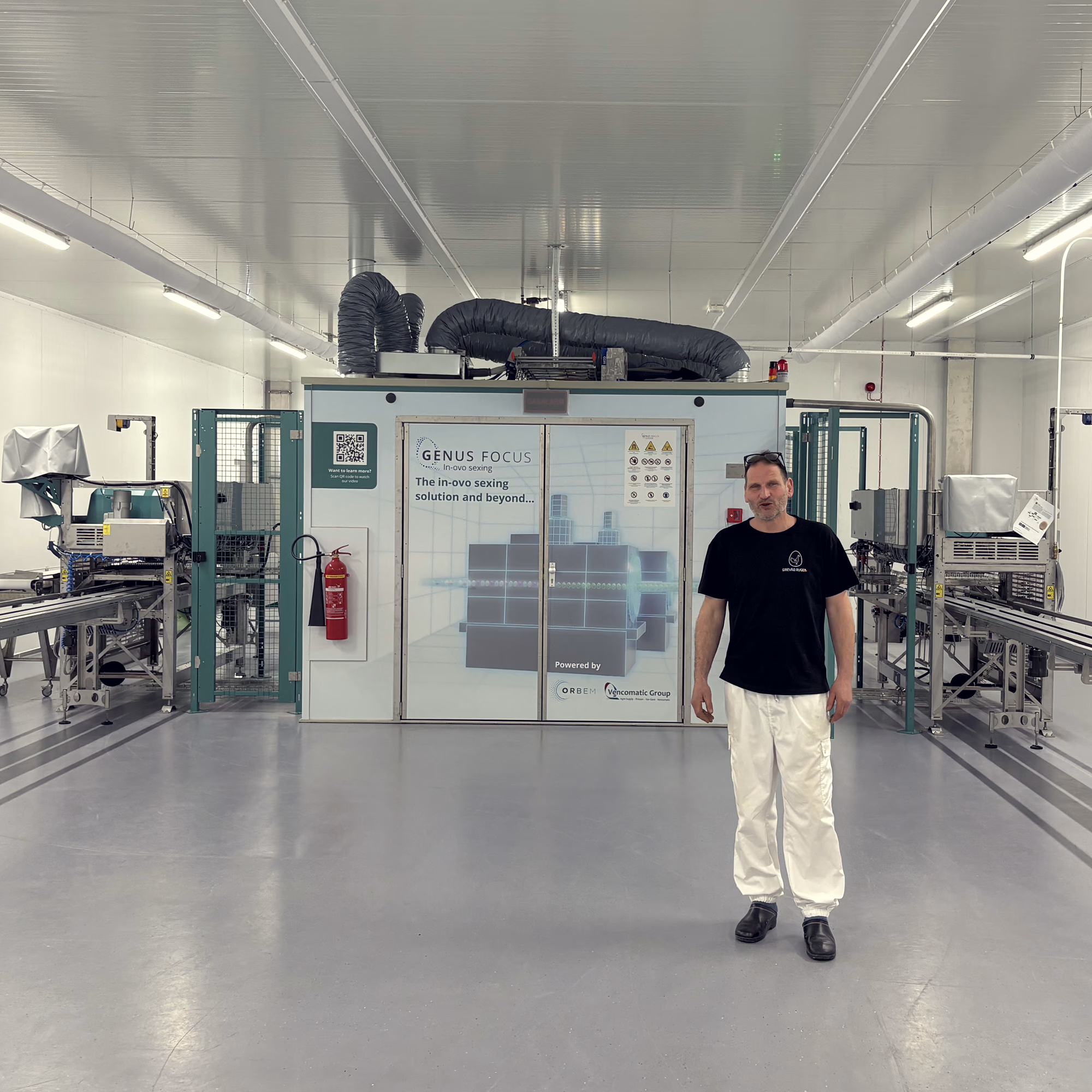
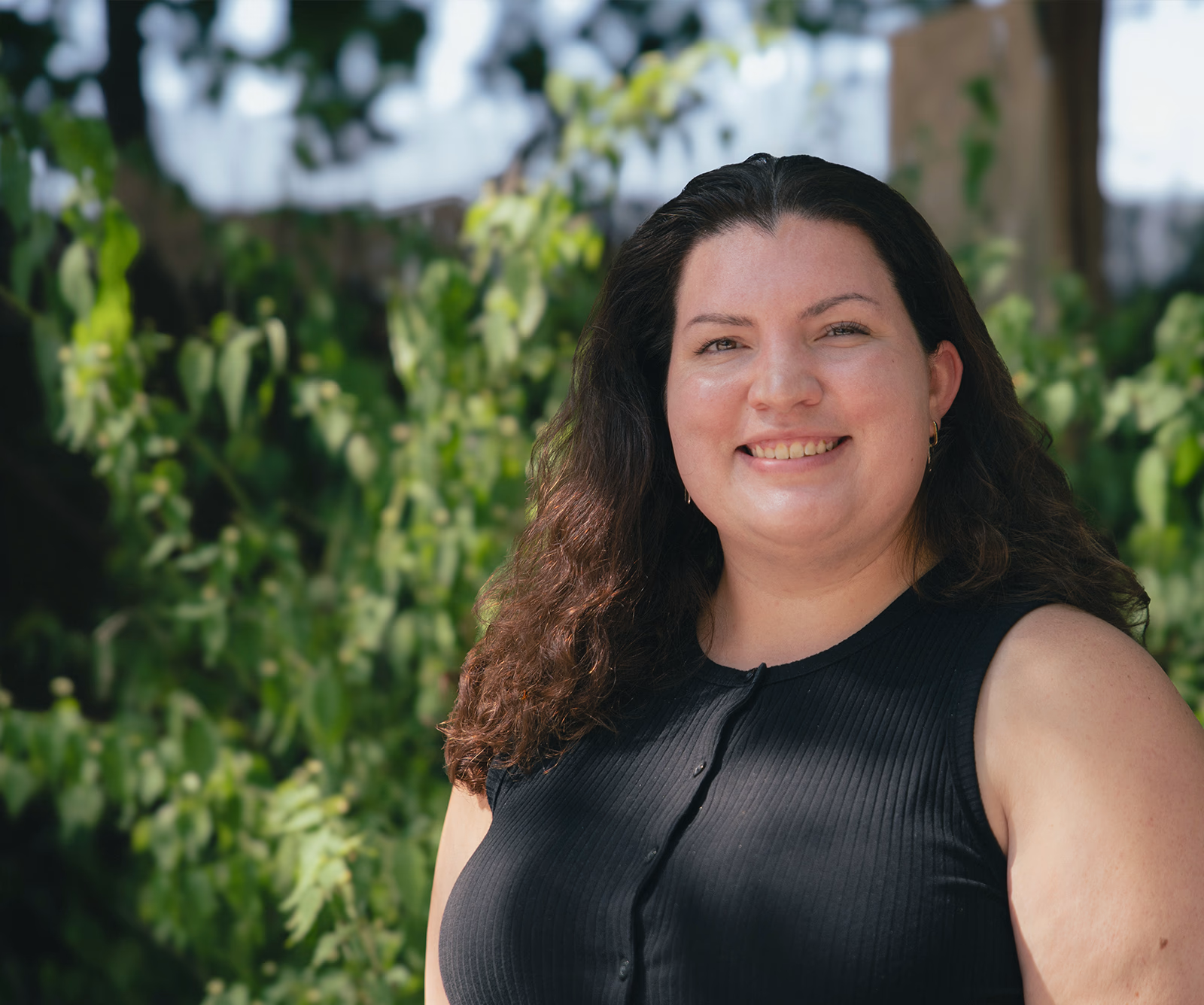
Two U.S. Genus Focus installations later and with a lively office in Houston, Texas, we sat down with one of our very first U.S. hires: Brooke Alley, Technical Support Manager.
Brooke walked us through how Customer Support keeps Orbem a trusted partner, ready to troubleshoot 24/7. She told us about the tools and ways of working that brought our support to the next level. And she explained why we are more than a technology provider to our customers.
Brooke, can you tell me a bit about your role in the U.S. team? What does your day-to-day look like?
I am a Technical Support Manager on the Technical Customer Support team (we call it TCS). I've been with Orbem for about a year and a half now. And what does my day-to-day look like? Because the U.S. team and the Europe team operate in different time zones, the first thing I do when I start work is to catch up on what the Europe team has been working on. Sometimes, the Europe team will hand something over to us so we can continue to provide support during their after hours. Then I spend the rest of my day watching out for any customer issues getting reported and I work on new ways in which we can support our customers’ operations.
Orbem opened an office in Houston last year. Would you say that it has proved important to be on the ground in the U.S. and to have a dedicated U.S. team?
It’s definitely a huge advantage to be on the ground in the U.S. and have a dedicated team that can travel to customer sites when needed and that can support our customers in their time zone, 24/7.
I also believe it has been very helpful to be able to build our own little team here in the U.S. from a cultural perspective. We get to meet, in person, at the office and I’m very happy about that. That helps with our U.S. operations not feeling disjointed from what happens in Europe and it gives us a sense of community. It also helps to have U.S. team members who understand how things work here as compared to Europe. That helps us as a team but also our customers.
You mentioned that we have people traveling to U.S. customer sites. Can you tell me who at Orbem does the traveling, what for, and why it is important to check in?
We have different teams who travel to be on site with our customers. Our Field Operations team probably travels the most since they are the ones who deliver, service, and maintain Orbem’s systems. Their work involves site planning, where they define layouts and ensure site readiness, as well as installation, maintenance, and field support when remote resolution by Technical Customer Support isn’t possible.
Then there’s our Applications team who travel to customer sites to ensure that we’re collecting the data we need to improve our systems. And of course there’s Business Development who check in regularly with all our customers and who attend conferences and the like to spread the word about Orbem or to explore new opportunities.
Does Orbem's Customer Support also travel to customer sites?
We are available to travel anytime our customers run into issues and have strategically positioned ourselves to be able to arrive quickly when needed. However, we are also able to offer comprehensive remote support to provide our customers with immediate solutions when every second counts.
We also like to introduce ourselves to the customer in person so they can connect a face to the name. It’s nice to give them the opportunity to ask us questions about what support will look like.
Can you walk me through what happens when someone raises a support ticket with us?
We have a triage process in place for all support tickets, meaning we’ll prioritize based on urgency. We’ll prioritize any issues that affect a customer’s operations on a larger scale. But we’re always trying to get everyone running again as effectively as possible.
We will always try to resolve any reported issue ourselves first, and in most cases we are able to. When that isn’t possible, we will either reach out to our in-house Field Operations team or we will reach out to our hardware supplier and ask them to take a look. It depends on what the reported issue was. If someone has to go on site, we will schedule that with our customer so we can provide a streamlined solution.
You mentioned 24/7 support earlier. How does Orbem's Customer Support make sure that all issues raised by a customer get addressed, no matter what time or day of the week it is?
We recently introduced a new tool called PagerDuty to manage incoming requests, and we're really happy with it. It does exactly what it sounds like: whenever there's a new alert, whoever is on call gets a call. We know nothing critical is happening unless that phone rings.
Before this, the process was very manual. For weekend support, we'd assign someone to watch the queue, which meant constantly checking their phone or laptop for requests across different channels. And we couldn't miss anything, because critical alerts, if not actioned, can mean downtime for our customers or that they lose trust in us.
Eventually everyone got tired of working this way, so we went looking for something less manual and less straining. I remember our Principal of Customer Experience, Shaun Parkin, saying, "We just need something that will page us." That's how I came across PagerDuty.
That sounds like a huge relief for your team.
It really was. We are saving time, but most importantly, we are reducing the mental load of providing support. I feel like whenever I worry about something, that’s really taking up all my mental energy. Now we can dedicate that energy to other things; I can open myself up to other challenges.
That’s fantastic. Having been around for a while now and seeing how our customers interact with us and how we interact with them, what kind of relationship would you say we have with them?
When I spent some time on site with our first U.S. customer, I got some feedback that I keep thinking about. The customer told me that whenever we say we’re going to do something, we absolutely follow through on it and we do even better than we promised.
I think that, especially with our U.S. customers, trust is the most important factor. Trust is the basis of any good relationship but it’s even more important in the U.S., where in-ovo sexing isn’t so well known yet and consumers just aren’t as aware of chick culling yet as they are in Europe.
We have to build trust with our partners here first. Hearing from them first-hand that whenever there is an issue, we’re addressing it, is the best possible feedback to get. It makes me proud that our customers know that if something goes wrong, we’re going to resolve it.
That is amazing feedback to get. You just mentioned the difference between U.S. and European audiences. I’d love to hear how you collaborate with our European team. Can you tell me a little bit about that?
We have bi-weekly check-ins across the entire team to make sure we are all on the same page. We also have an internal policy to do handover messages. Towards the end of your shift, wherever you are, you write a short summary to keep everyone aware of what’s going on. We mention which customers are scanning right now so we can keep an eye on them just in case.
We also have a shared ticketing system that we can integrate with other tools we use, like Airtable for Field Operations and Operational Excellence.
Has it always been easy to work across two time zones and collaborate smoothly? Is there anything you learned over time?
Oh, we’ve definitely improved many things over time and I’m sure that will continue happening. One of the biggest learnings I’ve had is that the time difference doesn’t mean we are isolated and it requires us to communicate especially well. Let me give you an example.
Our shared ticketing system takes a lot of configuration and fine-tuning and I was working on that only yesterday. When I started work today, someone had sent me a message about the specific configuration I did. Yesterday, I thought it would be completely inconsequential to others how I configured this. But today I realized that it wasn’t, because the Munich team wanted to know why something was set up a certain way.
I think one of the biggest learnings I’ve had over time is that we need to develop a universal kind of language. We need to adapt and continuously improve our communication so nothing falls through the cracks. It’s easy for context to get lost but when you communicate well, that’s a lot less likely to happen.
Is there anything else that you think makes your team work well together?
Well, something that is sort of unique about us is that we all come from such different backgrounds. That holds true for Customer Support and for Orbem as a whole. In my experience, a lot of people imagine a particular kind of person working in Customer Support. But here at Orbem, I’m experiencing a new level of background diversity.
What I really enjoy about that is that we all have different strengths and weaknesses. We can learn a lot from each other. We help each other out whenever there’s something someone else might find easier to grasp. And I think that’s really beautiful. I haven’t ever seen that before.
Of course, it can be challenging having people with such different skillsets and backgrounds on one team too. But it’s just as encouraging. I get to put myself in someone else’s shoes and try to see the world from their perspective. Something that seemed obvious to me might not be as obvious to someone else. Having to question my own assumptions and explain myself every now and then has been really helpful to my professional development as well.
Thank you so much for sharing, Brooke. I have one final question for you.
What would you tell someone who is currently looking for an in-ovo sexing solution in the U.S.?
I’m seeing this from a Customer Support angle, but I think that doesn’t make it any less true: We are there for you 24/7. We are real people working from Houston and we’re only a phone call or message away.
I think it all comes down to the trust element I spoke about earlier. If you talk to any of our current customers, trust is a key word that will come up. With Orbem, you know what you’re going to get. We’re never going to leave you out in the cold to handle any issues by yourself. We take ownership and it truly fulfills us to provide not only a product but also a service that we are all proud of.
About the Author

Barbara Jilek, Senior PR and Content Marketing Manager
Barbara builds relationships with journalists and tells Orbem’s story on all our channels as well as anywhere else people will listen.