Four commercially important defects can remain hidden inside apparently healthy watermelons: hollow heart, internal impact damage, viral fruit degeneration, and overripeness. Here is what they are, where they occur, and how AI-powered MRI finds and measures all four in a single non-destructive scan, so that every fruit is graded on what is actually inside it.
What is the impact of internal defects in watermelons?
Watermelon is one of the most widely cultivated fruits on Earth. FAOSTAT reports global production of approximately 105 million metric tons in 2024, with China accounting for more than 60% of the total [ref]. IndexBox puts the 2024 market at $69.5 billion in consumption and $72.3 billion in production value (at estimated export prices), and identifies Spain as the world’s largest exporter by volume [ref]. Within the EU, the most recent Eurostat breakdown, for 2022, attributes 45.4% of production to Spain, 25.6% to Italy and 12.4% to Greece [ref].
Because of the watermelon's thick-skinned nature, a fruit may pass visual inspection and still contain internal defects such as a hollow heart, internal bruising, virus-associated tissue breakdown, or an overripe core [ref]. At the watermelon production scale, every kilo counts. Even a small defect rate represents substantial exposure: one percentage point of global production is roughly 1.05 million metric tons, and one percent of the estimated 2024 market value is about $695 million. Researchers have investigated non-destructive technologies for assessing individual fruit for decades. Acoustic, optical, microwave, and X-ray approaches can each measure selected attributes, but each involves trade-offs in penetration depth, spatial localization, contrast, or industrial throughput [ref, ref]. Conventional grading based on visual checks, tapping, and destructive sampling can therefore leave hidden defects undetected, resulting in retailer claims, downgraded shipments, and avoidable food waste.
Detection alone is not enough for commercial grading. Buyers set limits for attributes such as cavity size, affected tissue, firmness, or soluble solids. Existing methods can quantify selected signals or quality proxies, but they do not necessarily localize and measure a deep internal defect in three dimensions. A grading system needs to show not only whether an abnormality is present, but also how large it is, where it is, and how much of the fruit it affects; and it needs to do so for every fruit, not for a sample.
Below are the four defects in turn: what each is, where it occurs, how frequently it may appear, and which technologies can detect or measure it.
Defect 01: Hollow heart
What it is
Hollow heart is among the most commercially significant internal defects in modern watermelon production, and its prevalence has grown with the industry’s shift toward seedless varieties, which now account for 90–95% of the U.S. market [ref]. Seedless watermelons are triploid: they carry three sets of chromosomes instead of two and do not produce viable pollen. They therefore depend on diploid, seeded pollenizer plants and on bees to deliver the pollen needed for fruit development. When pollination is inadequate, the placental tissue at the fruit’s center may fail to develop fully, leaving a crack that expands into an open cavity as the fruit grows [ref].
Pollination is not the only factor. Susceptibility also varies with cultivar, tissue firmness, and conditions during fruit set; cold or wet weather can reduce bee visits or pollen release [ref]. Affected fruit may sometimes be asymmetric or elongated, but external shape is not a reliable diagnostic sign, which is why hollow heart cannot be sorted out by eye on the packing line.
Where it occurs: The central placental region; a gap or cavity where the flesh should converge at the core.
How often: Incidence is highly variable. In preliminary field trials, beds with normal pollinizer spacing showed no hollow heart, while incidence reached 56% at 1.5 meters and 74% at 2.4 meters from the nearest pollinizer crown [ref]. Cultivar, pollination, and weather during fruit set all influence the outcome, so no grower can rule hollow heart out of a given lot before it is graded.
How to detect it: Acoustic impulse response is one of the most studied non-destructive approaches. Diezma-Iglesias et al. reported that an acoustic device correctly classified hollow versus sound fruit in about 78% of cases, compared with 72% for experienced handlers; when all internal quality disorders were pooled, accuracy rose to 89% versus 83% [ref]. Simón-Portillo et al. later reported classification success above 89% using vibrational parameters and machine learning [ref]. These controlled studies show that acoustic inspection can outperform manual tapping. Even so, 11–22% of fruit were still misclassified, and performance depends on the dataset, cultivar, and calibration.
Acoustic signals do carry some information about hollow heart: certain signal features correlate with cavity volume. But a correlation is not a measurement. The acoustic response of a watermelon also shifts with ripeness, tissue density, and rind thickness, so the same signal can mean a large cavity in one fruit and a slightly softer flesh in another, and the estimate drifts as the fruit changes. Nor does a sound wave travelling through the whole fruit say where the cavity is or what shape it has. X-ray methods have limits of their own. A conventional X-ray produces a single flat image, like a shadow of the fruit, so a cavity can be masked by the dense flesh in front of or behind it. X-ray CT takes many such images and stacks them into a 3D model, but it exposes the fruit to ionizing radiation and struggles to tell different types of water-rich tissue apart: it can see a hole, but not necessarily damaged flesh.
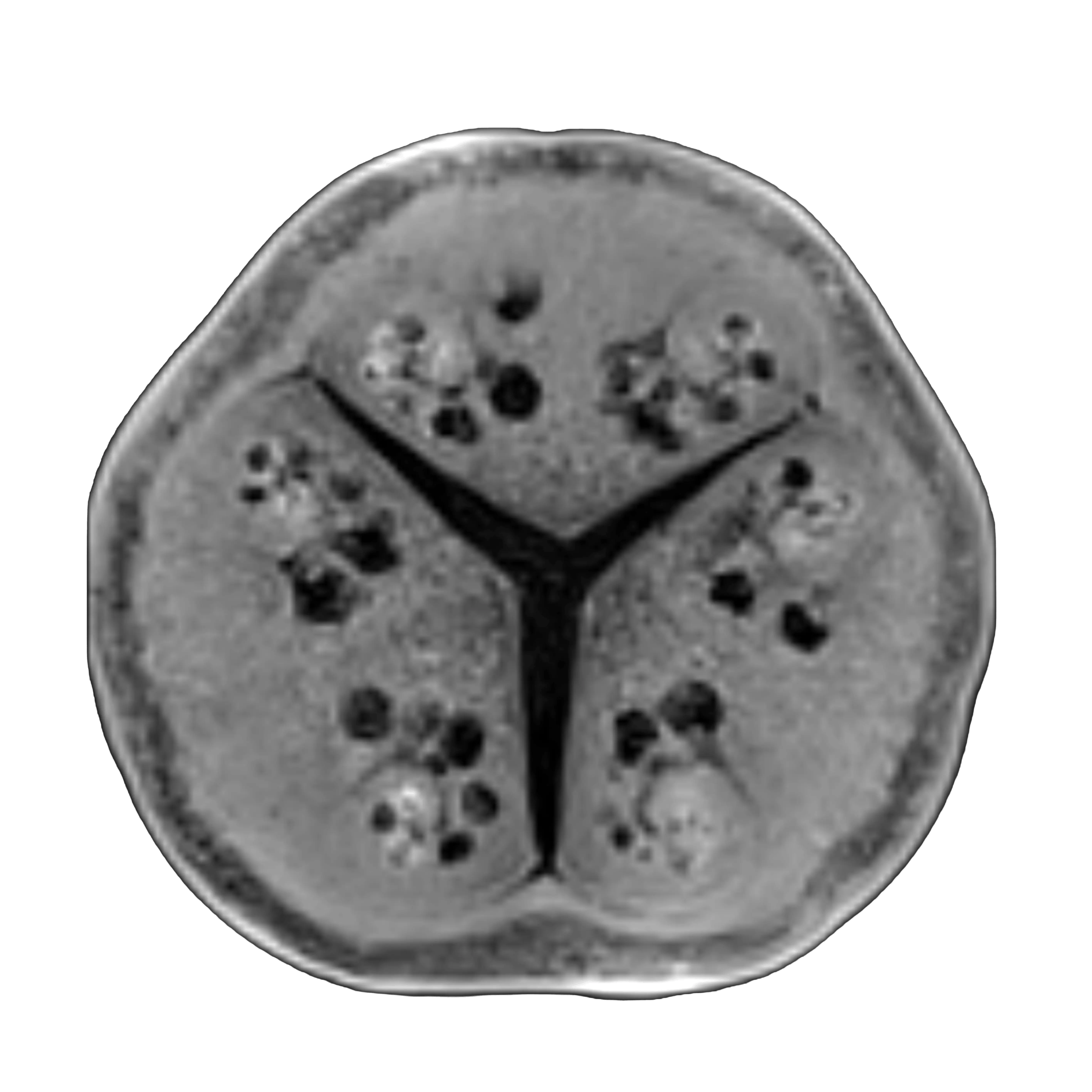
AI-powered MRI images the cavity directly, in three dimensions, on the intact fruit: its volume, shape, and position relative to the placental tissue. The cavity volume becomes a number for every single fruit, and that number drives the grade: pass, downgrade or reject against a threshold the customer defines, with the measurement documented per fruit. With Orbem, hollow heart stops being a risk absorbed through claims and becomes an attribute sorted out at the line, with the evidence to back every decision.
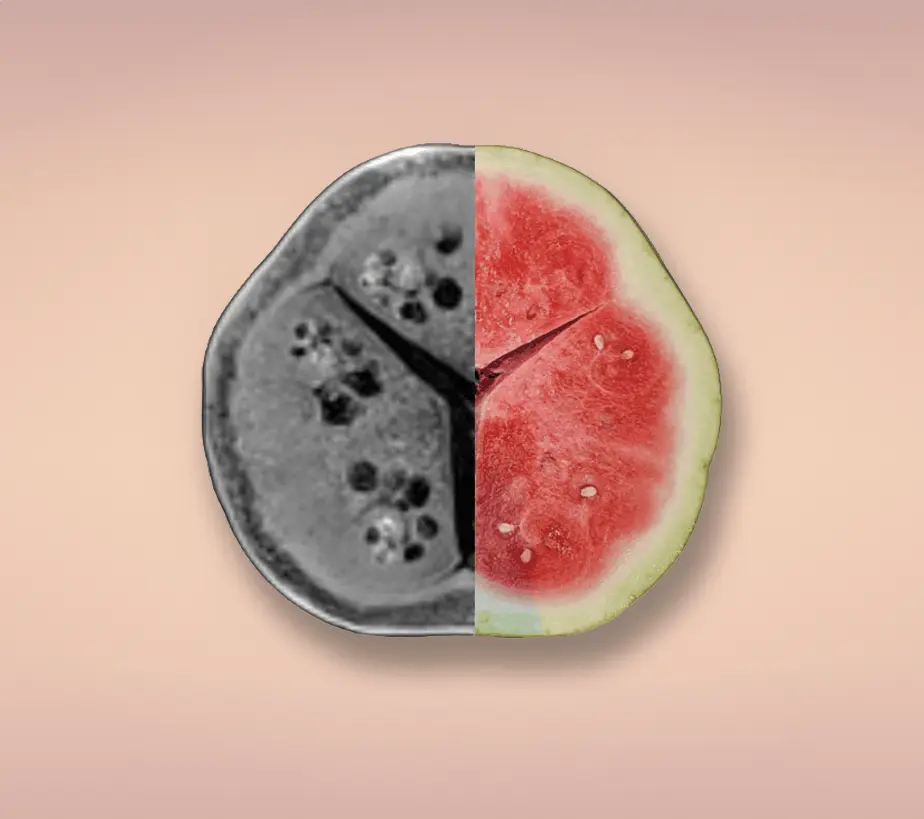
Seeing it for yourself: MRI scan and physical cut
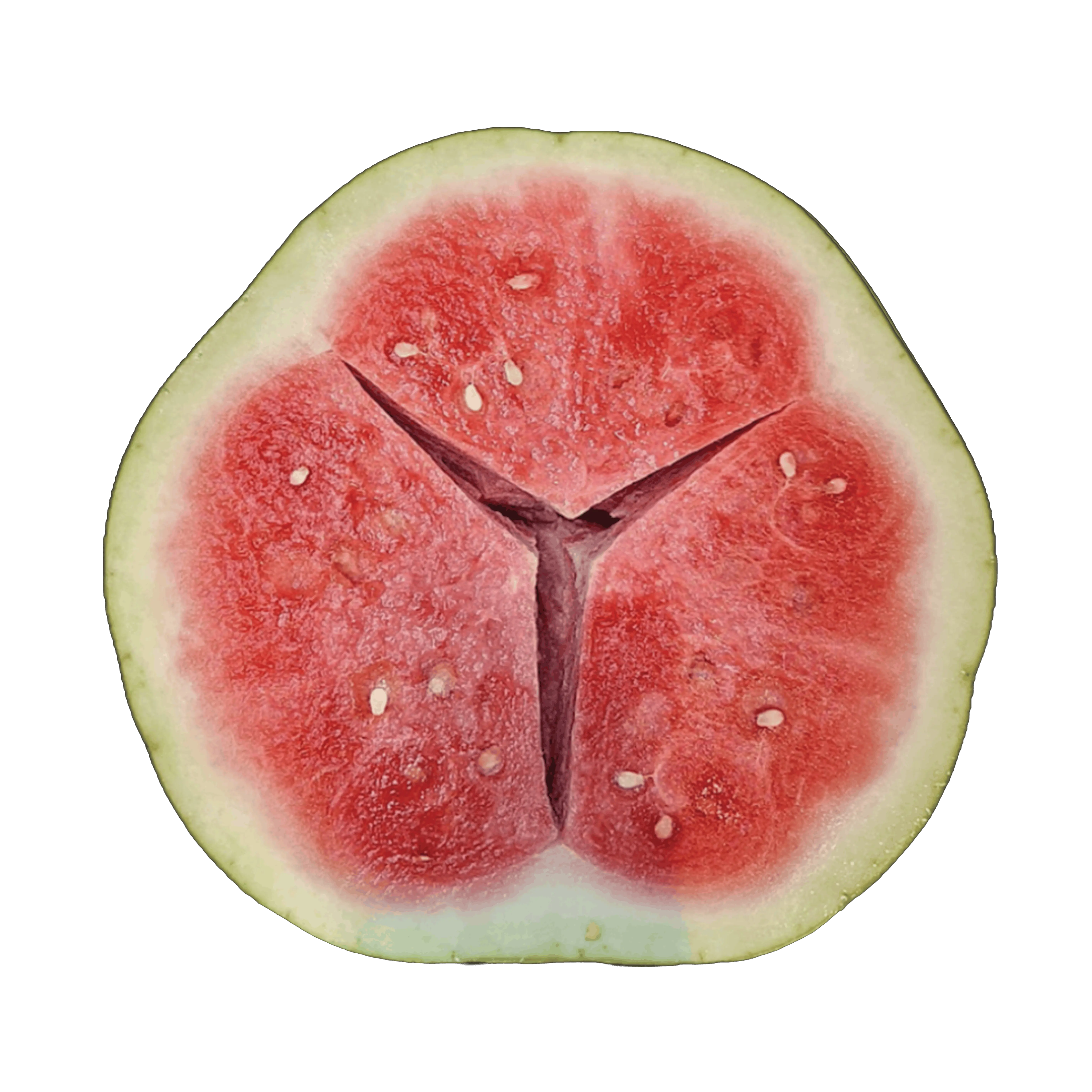
Left: AI-powered MRI cross-section of a whole, uncut watermelon, showing a dark irregular void at the center; hollow heart, visualized without touching the rind.
Right: The same watermelon sliced open, confirming the cavity’s exact size, shape, and position.
The fruit on the left was never cut, damaged, or altered to produce that image; yet it shows the same information as the knife.
Defect 02: Internal impact damage
What it is
Watermelons are large, heavy fruits that are subjected to mechanical loads throughout the supply chain: picking, crate loading, transport vibration, and repacking. Impacts and compression can rupture cells in the flesh beneath an apparently intact rind. Finite-element modeling and compression testing show that the red flesh reaches its failure stress well before the rind does, which explains how internal damage can occur without visible external injury [ref]. The resulting softened or water-soaked tissue may only become evident when the fruit is cut.
Where it occurs: Potentially anywhere in the flesh, most often beneath or near the region that absorbed the load. Position and extent depend on the direction and magnitude of the load and on the fruit’s tissue properties.
How often: No defensible watermelon-specific incidence rate exists for commercially handled fruit; prevalence depends on harvesting, packing, and transport conditions. Across fresh horticultural produce as a whole, bruising and other mechanical damage have been estimated to affect up to 30–40% of product between harvest and market [ref]. Because it varies from lot to lot, only inspecting every fruit reveals how much of it is actually there.
How to detect it: Acoustic and vibration sensors capture a bulk response from the whole fruit. A localized bruise may have only a small effect on that signal, and the measurement does not show where the damaged tissue lies. Cutting provides direct evidence on the exposed plane, but the sampled fruit is lost. Statistical sampling can estimate lot-level risk; it cannot determine the internal condition of every uncut fruit in the pallet.
AI-powered MRI images the altered tissue at depth and measures its location and extent, so a shallow affected region just below the rind and a large zone extending toward the core can receive different grades rather than a blanket rejection, protecting yield as well as quality. Combined with batch, time, and handling records, scan results also reveal trends that help a packer pinpoint where damage is being introduced and target process improvements. With Orbem, impact damage is no longer discovered by the customer: it is measured, graded, and traced to its source before the pallet leaves the packhouse.
Defect 03: Viral fruit degeneration
What it is
Viral infection can damage watermelon flesh internally even when external symptoms are absent or inconsistent. Cucumber green mottle mosaic virus (CGMMV) is a tobamovirus first reported in England in 1935 that has since spread across the major production regions. It infects cucurbits including watermelon, melon, cucumber, squash, and pumpkin, and is transmitted through contaminated seed and direct contact with infected plant material [ref, ref].
In watermelon, CGMMV can cause internal discoloration, sponginess, uneven ripening, and tissue breakdown, a syndrome sometimes described in the literature as watermelon blood flesh disease. The flesh may become water-soaked and dirty red or yellow, and severe cases can develop cavities. External symptoms are variable: brown necrotic lesions on stems or peduncles can occur, but symptom-based identification is unreliable because presentation depends on cultivar, environment, and growth stage [ref, ref].
Where it occurs: In the flesh, potentially across large contiguous areas of internal tissue; surface symptoms are often absent.
How often: The NSW Department of Primary Industries and Regional Development reports potential yield losses of 15–50% in cucumber and watermelon through reduced yield and poor fruit quality [ref]. Within an affected lot, the share of fruit with internal symptoms varies, which is why grading has to be done fruit by fruit.
How to detect it: Laboratory tests such as RT-PCR and ELISA confirm the pathogen. They require representative sampling and answer a different question from inline grading: whether CGMMV is present, rather than how much commercially unacceptable tissue each fruit contains. Visual symptoms alone are not sufficient for diagnosis [ref, ref].
AI-powered MRI assesses the condition of the flesh, not the identity of the pathogen. It can flag and quantify internal patterns consistent with water-soaked, spongy, or structurally altered flesh in fruit approaching shipment, so that a lot known to carry infection is not written off wholesale: sound fruit is shipped, affected fruit is held back, and the share of unacceptable tissue is recorded for each. This supports fruit-by-fruit commercial grading; it does not replace phytosanitary sampling, laboratory confirmation, or applicable biosecurity requirements. Used together, diagnostic testing manages the pathogen while Orbem’s MRI protects the saleable volume: every sound fruit from an affected lot still reaches the market, with the data to prove it.
Defect 04: Overripeness
What it is
Watermelon is a non-climacteric fruit: it does not gain sweetness after harvest. Postharvest quality can nevertheless deteriorate during prolonged storage or temperature abuse. In one storage study, total sugar content declined by 4.3%, while the change in firmness was not statistically significant [ref], so firmness alone will not flag an overripe fruit. Commercial overripeness is therefore best defined by the fruit’s actual condition; mealy, less juicy, or insipid flesh; rather than by storage time alone [ref].
The commercial weight of the defect is codified in the U.S. Standards for Grades of Watermelons, which treat overripe fruit as serious damage in any degree. Lot tolerances depend on grade and inspection point: the total destination tolerance, for example, is 10% for U.S. Fancy and 12% for U.S. No. 1 [ref].
Where it occurs: Across part or much of the edible flesh. The pattern varies from fruit to fruit and does not necessarily progress from the core outward, so a single probe point can miss it.
How often: No defensible incidence rate exists for commercial lots; the risk depends on harvest maturity, storage duration, and temperature management [ref, ref].
How to detect it: Acoustic methods provide a bulk mechanical response and cannot map a localized internal texture gradient. NIR is useful for attributes such as soluble solids, but its light penetrates only about 9–11 mm into intact watermelon, leaving the deeper flesh out of reach [ref]. Destructive sampling estimates lot-level condition but cannot grade each fruit.
AI-powered MRI does not rely on texture alone. As a fruit passes its peak, what MRI sees changes in several ways at once: the water state of the flesh and its relaxation properties shift, and so do structural landmarks such as the tissue around the seeds and the fruit’s internal vascular network, effects that MRI studies of fruit ripening have documented [ref]. Orbem’s models read these ripeness signatures together with the texture change across the whole fruit and quantify how much tissue is affected. This allows packers to route each fruit by its real condition into near-term sale, longer distribution, or rejection, against thresholds validated with the customer, so that fruit is neither rejected while still saleable nor shipped only to come back as a claim. With Orbem, ripeness is graded from the inside of every fruit, so what you promise the customer is what arrives on the shelf.
Technology comparison
What this means for your packing line
Every watermelon that leaves a packhouse with a hidden defect is a claim waiting to happen: a downgraded pallet, a rejected shipment, a consumer who does not buy the brand again. Sampling catches a fraction of the problem; tapping catches less. Whole-fruit MRI grading changes the equation: every melon is seen inside and measured, every grade is a number rather than a guess, every decision is recorded, and the fruit that reaches the shelf is the fruit you would have chosen yourself with a knife in hand — without the knife.
If you grow, pack, or buy watermelons at scale, the fastest way to find out what is really inside your fruit is to scan it: talk to Orbem.
Why surface-based technology cannot cover all four defects
The four defect classes share one practical problem: the relevant tissue may lie at an unpredictable depth inside a fruit that is difficult to inspect from the surface. Many widely used non-destructive systems are optical and are therefore strongest at or just below the surface.
Near-infrared spectroscopy measures the spectral response of reflected or transmitted light. A 2023 study measured a maximum penetration of approximately 9–11 mm in intact watermelons [ref]. NIR can still predict selected attributes such as soluble solids, but it cannot reconstruct the geometry of a deep cavity or bruise. Hyperspectral imaging is likewise strongest for surface and near-surface spectral information. Microwave sensing penetrates deeper but generally provides limited spatial detail, while terahertz radiation is strongly attenuated by water-rich produce [ref, ref].
AI-powered MRI uses a static magnetic field and radio-frequency pulses to generate contrast from hydrogen nuclei, mainly those in water, without ionizing radiation. Unlike optical methods, it is not constrained by a shallow light-penetration depth. Making it fast enough for a packing line is an engineering challenge of system geometry, signal-to-noise ratio, and acquisition time; the same challenge Orbem has already solved at industrial scale in poultry. MRI was demonstrated on whole watermelons as early as 1996, when a rapid one-dimensional projection profile correctly classified internal voids in 28 of 30 fruit [ref]. Modern Orbem systems reconstruct three-dimensional internal images and use machine-learning models to convert them into automated grading decisions. In Orbem’s internal watermelon validation, the approach has detected hollow heart, impact damage, viral fruit degeneration and overripeness, and has quantified attributes such as affected volume, position and extent.
Already proven at industrial scale
The step from laboratory MRI to a production line has already been taken in poultry. In 2023, Hendrix Genetics and Orbem announced the launch of an automated MRI-based in-ovo sexing installation with a capacity of 250,000 eggs per day [ref]. Today, the Genus Focus system scans an egg in less than one second, handles up to 3,275 eggs per hour per module, and scales to 24,000 eggs per hour in a modular configuration, with no measurable effect on hatchability and fewer than 1% males among the chicks hatched from female-classified eggs [ref, ref]. Systems are deployed in France, Germany, the Netherlands, Norway, Switzerland and the United States, where the first installation began operating in July 2026 [ref, ref]. The same combination of accelerated MRI, automation and AI is now being applied to watermelon grading: the physics is proven, the throughput is proven, and the operating record is public.
Frequently asked questions
What are four commercially important internal defects in watermelons?
Four commercially important internal defects are hollow heart, internal impact damage, fruit degeneration, and overripeness. Each can be partly or completely hidden from external inspection, so none of them can be ruled out by looking at the rind.
Is hollow heart only caused by poor pollination?
Inadequate pollination is a primary cause, especially in seedless triploid varieties, which depend on neighboring pollinator plants. Cultivar susceptibility, weather during fruit set, and placental tissue firmness also contribute [ref]. Because none of these factors can be controlled completely in the field, grading the harvested fruit remains the only way to guarantee what reaches the customer.
What quality parameters determine watermelon value in the supply chain?
Commonly considered quality attributes include soluble solids, size, flesh firmness, acidity, and internal color. A fruit can score acceptably on all of these and still carry a hidden cavity, bruise, or virus-associated lesion that only appears when the consumer cuts it open.
Does MRI only detect internal defects, or does it measure them?
MRI both detects and measures internal abnormalities. Acoustic, NIR, and microwave methods can also produce quantitative signals for selected attributes, but they do not provide a complete three-dimensional map of deep defect geometry. MRI quantifies the volume, position, and extent of a cavity or altered tissue, so a buyer's specification can be enforced on every fruit rather than estimated from a sample, and each grade is backed by a measurement instead of a simple sound-or-defective call.
How can you assess a watermelon’s interior reliably without cutting it?
Traditional external cues provide only an indirect estimate of internal condition. In controlled studies, acoustic methods classified hollow or internally disordered fruit with approximately 78–89% accuracy, but spatial localization remained limited [ref, ref]. Orbem’s AI-powered MRI is designed to image the fruit from rind to core, identify the four defects described here, and convert the three-dimensional result into an inline grading decision for every single fruit.
Latest articles

Food Waste Starts with a Decision Made Too Late
Climate change, labor shortages and market volatility put agricultural businesses under pressure. Artificial Intelligence helps the sector make decisions while they still matter, to reduce food waste, gain a competitive advantage, and increase operational resilience.